Construction company website design that gets you on the bid list
We design websites for general contractors, design-build firms and commercial builders. The site is built for the people who check you before a bid: the owner’s representative, the architect and procurement. It answers their questions before they call, because many of them never call at all if the site doesn’t.
GK Neo: more tender invitations after launch · 150+ projects since 2015 · 5.0 on Google and Clutch, 50+ reviews
Who checks a construction company’s website before a bid
Every reviewer checks their own part:
The architect
Looks at the level of your projects: what you have built, how complex, in which sectors.
Procurement
Looks at documentation, prices and the commercial proposal: can they get what they need without chasing you?
The owner’s representative
Judges the company as a whole: is this a real, stable builder that can carry the job?
What a good construction website needs
Project cards by sector
A water treatment plant, an office building and a shopping center are different jobs. Each project gets its sector, scope, size, timeline, your role and real photos, and visitors filter by sector.
Prequalification in one place
Licenses, insurance, certifications and clearances, bonding capacity: all must-haves. A page a reviewer can scan in a minute, with documents to download or request.
Team and experience
The people who run your jobs, their years and the work they led.
What you build and how fast
Say plainly which sectors and project sizes you take and on what timelines. Most contractor sites never do.
A bid and proposal path
A short form that asks what an estimator needs (project type, location, size, timeline, drawings upload) and goes straight to the right person or your CRM.
Service area
Where you work, with a page per region if you bid in several.
Real photos and drone footage
If you don’t have them yet, we can generate images for the launch, and we always plan the real shoot: AI reads generated images for what they are, and real projects are what sell.
Fast and mobile-first
Reviewers open your site between meetings and on job sites.
Construction company website structure, page by page
A construction company website isn’t one long page. Each page answers one reviewer and one question:
Homepage
What you build, for whom, in which region, and the size of jobs you take, in the first screen. Then three or four strongest projects, the prequalification block and one clear path to a bid or a proposal.
Service pages
One page per service or sector: commercial construction, design-build, tenant improvements, public work, industrial. Each with its own projects, so search engines and reviewers see you do that work.
Project pages
Every finished job gets its own page in the showcase: sector, scope, size, timeline, your role, the owner (if allowed), photos and drone footage. Project pages rank on their own and are what architects open first.
About and team
The people who run your jobs, with their experience, and your history.
Safety and quality
Safety record, programs and certifications, in one place.
Prequalification
Licenses, insurance, bonding capacity and clearances, with downloadable documents or a request form.
Careers page
Construction companies hire all the time; a careers page with open roles also shows reviewers a company that is growing.
Contact page
A contact form for general questions and a separate bid-invitation form that asks what estimators need.
Construction website design mistakes we see most
Too loud, too little information
Big video, slogans, and no layer that answers the reviewer’s questions.
The wrong message for the audience
Talking to homeowners when your buyers are developers and public clients, or the other way round.
Not saying what you build or how long it takes
Talking about how great you are
Instead of what the client needs to see.
No prequalification documents
So procurement moves on to the next bidder.
Commercial contractors and home builders need different sites
We build both; the structure is decided in Discovery.
Sector project cards, prequalification documents, bonding and safety, a bid path. The site sells to a committee.
Architecture first, plans and communities, a path to a consultation. The site sells to a family or an investor.
Commercial construction website design
Commercial construction websites sell to a committee, not to one person. The owner’s representative, the architect and procurement each look for their own proof, and they compare you with two or three other contractors in the same afternoon. That changes the design:
The homepage leads with sectors and project size, not with a slogan
Project pages carry numbers (square footage, contract value if allowed, schedule) next to the photos
Testimonials come from owners and architects, with names and titles
The bid path is short and routes to an estimator, not to a shared inbox
Construction website design case studies
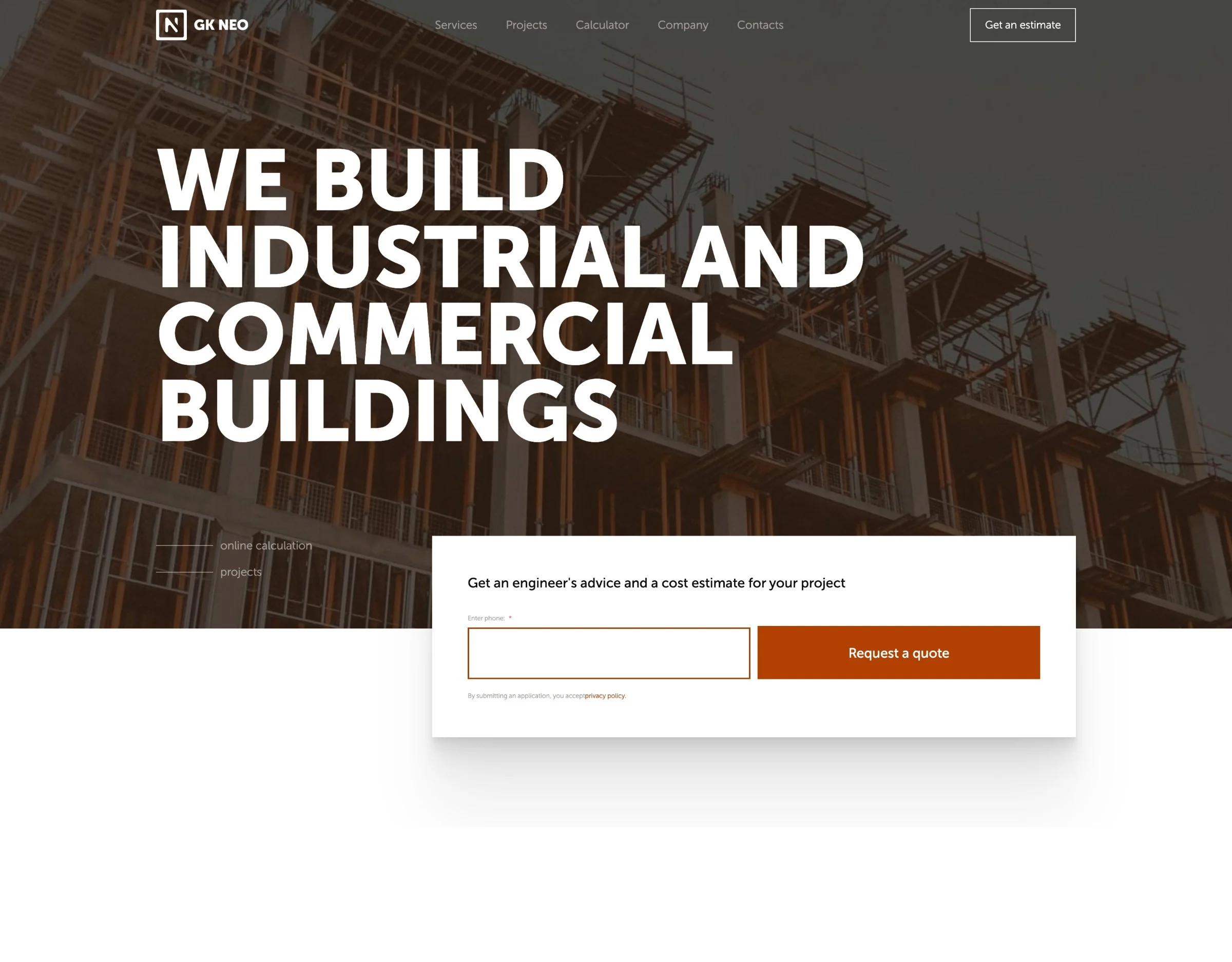
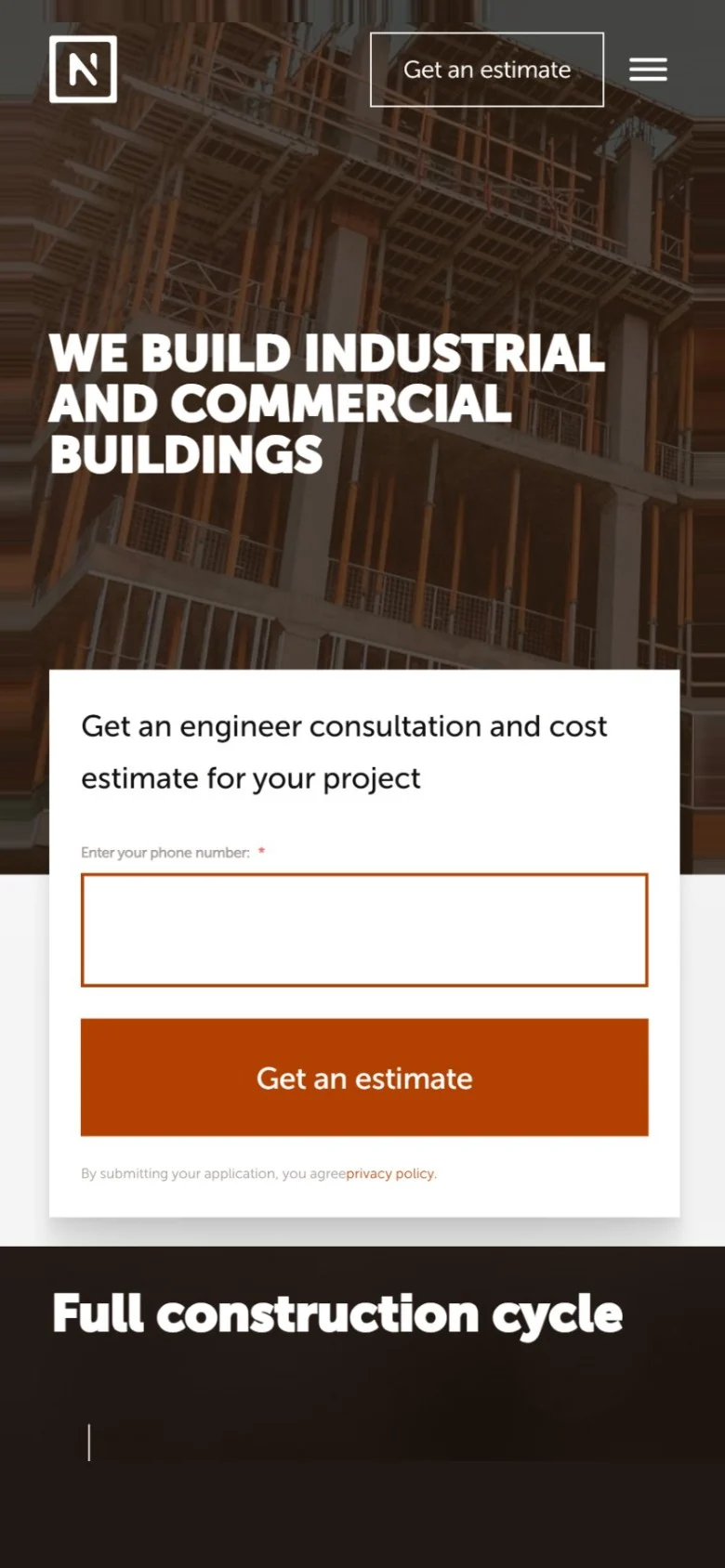
Name, identity and a multi-page site with a construction cost calculator. After launch, invitations to public tenders with large contract volumes increased.
Our construction website design process
1. Discovery
About a week, $1,200, credited to the site if it starts within 30 days: your market, the contractors you lose bids to, your sectors and reviewers.
2. Structure and mockups
Project cards, prequalification, bid path; edits until you approve.
3. Build and content
From your material and an interview; real photos planned.
4. Launch
Redirects from the old site, analytics, form tracking, a walkthrough of the admin.
Prepayment per stage; stop after any stage and keep the work you paid for.
A typical custom site takes 8–10 weeks.
Brand, logo and photos
If your brand looks older than your work, the site can’t fix it alone. For GK Neo we created the name, logo and identity first, then the site. When you have no professional project photos yet, we launch with generated visuals and plan a real photo and drone shoot. High-quality images of real projects are what convince reviewers.
Construction website design cost
The price is fixed in writing before you pay anything.
A custom construction site
Project cards, prequalification, a bid path; after Discovery.
Many projects, a complex structure
Where a company with many projects typically lands.
After launch: get found for the work you want
The site is the base. SEO and AI search bring developers and owners searching for your sector and region, and Google Ads fill gaps while SEO grows. See construction marketing. More ideas: construction marketing strategies.
Construction website SEO, built in from day one
A good construction website is built to be found, not only to look right:
A service page for every sector and a page for every region you bid in
Project pages that search engines can index, with real text, not only galleries
Clean structure, fast pages and structured data (organization, services, projects, FAQ)
Google Business Profile and directory profiles that match the site
Titles and descriptions written for the searches owners and developers actually type
You ask,
we answer
- What makes a good construction website?
It shows what you build and how big, has a project page for every significant job, puts prequalification documents in one place, loads fast on a phone, and gives a short path to request a proposal.
- How much does a construction company website cost?
A custom site starts at $7,500 after Discovery ($1,200, credited). With many projects and a complex structure it typically lands at $10,000–15,000.
- How long does it take?
About 8–10 weeks from kickoff for a custom site.
- Our work comes from referrals. Why do we need a website?
Because every referral checks you there first. If the site doesn’t answer the architect, procurement and the owner’s rep, many of them won’t call.
- What should a general contractor’s website include for prequalification?
Licenses, insurance, certifications and clearances, bonding capacity, safety record, project cards by sector, the team, and a clear way to request documents or submit a bid invitation.
- We don’t have good project photos. Can you still build the site?
Yes. We can launch with generated visuals and plan a real photo or drone shoot to replace them.
- Do you work with home builders and subcontractors?
Yes. The structure changes: home builders sell to families and investors, subcontractors to general contractors.
- Do you build on WordPress?
On a modern stack (Astro with a headless CMS) by default, or WordPress if you want traditional hosting. Either way it’s yours after the final payment.
- Should a construction company website have a careers page?
Yes. You hire all the time, and a careers page with real roles also tells reviewers the company is growing.
- Do you use website templates?
No. Every construction website is designed for your sectors and reviewers, built on a modern stack or WordPress, and yours after the final payment.
- Where are you based?
Leander, just north of Austin, Texas. We take projects anywhere in the US.