
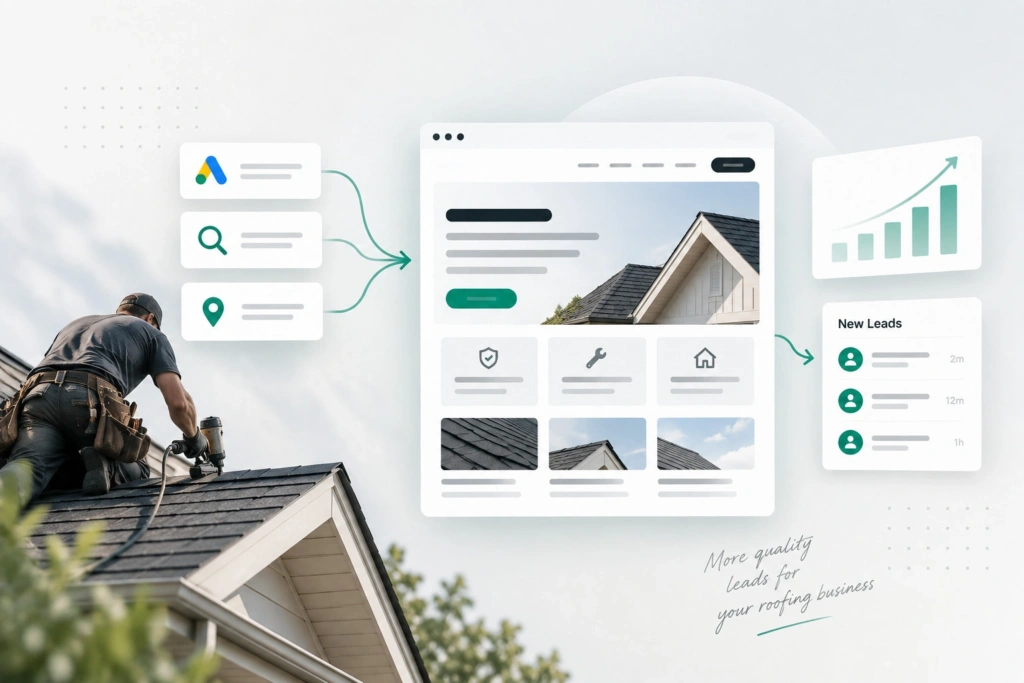

Most roofing landing pages convert at 1-2%. Ours convert at 6-7%. Here’s the exact design we used to generate $300K in closed business for roofing clients across the US — and why it works.
In this article, we’re diving deep into the exact landing page design that has generated hundreds of thousands of dollars for roofing clients in the US. You’ll be equipped to enhance your marketing efforts with proven strategies and insights for effective roofing service promotion.
Why a Strong Landing Page Matters
A well-crafted landing page is crucial for converting visitors into leads and should include a strong CTA. The decent conversion rate for a roofing landing page is 6-7%. What we can deliver for roofing companies based on a well-designed landing page template:
- Total Pipeline Value: Over $1,000,000
- Closed Business: $300,000 in revenue generated from effective Facebook & Google ads.
- Conversions: 300+
- Average Cost per Lead: $50

Understanding Your Audience
Understanding your audience is crucial when creating a landing page that effectively captures their attention and drives conversions. Your roofing website should feature a compelling headline that resonates with potential customers.
Utilize action verbs throughout the page to compel visitors to take action. Incorporating video testimonials can add authenticity to your message, showcasing your company’s benefits through real customer experiences.
Utilizing our web development services, you can build conversion-focused landing pages. We will ensure that your page design is visually appealing, incorporating images of your roofing associations and certifications to enhance credibility.
A strong call to action should be strategically placed, encouraging users to enter their phone numbers or click on your Facebook ads for more information. Monitoring page performance will help you refine your approach and ensure the success of your marketing campaign.
Our primary focus is new roof inquiries, ensuring we effectively target cost-based keywords. This filters out leads that may be looking for roof repairs, allowing us to concentrate on those ready for a complete roof replacement and design a landing page specifically for them.
Landing Page Design Breakdown
Creating a landing page SEO is essential for any successful landing page and marketing campaign, especially in the roofing industry. The design should be conversion-focused, compelling visitors to take action. Start with a strong headline that captures attention and communicates your company’s benefits. Use action verbs throughout the landing page to encourage users to click and explore further. Incorporate high-quality images of your roofing associations and certifications to establish trust and credibility.
Including video testimonials can significantly add authenticity to your message, showcasing real customer experiences that captivate your audience. Ensure your prompt call-to-action buttons encourage users to provide their phone number or request a quote.
By following these guidelines, you can create the perfect roofing landing page that drives conversions and maximizes the effectiveness of your PPC campaign.
Let’s walk through the essential sections of winning landing page design.
1. Hero Section
The hero section is the first thing visitors see. It must convey clarity and professionalism. Use a striking image of a person on a roof to ensure visitors immediately recognize they are in the right place.
This powerful visual captures attention and instantly communicates our roofing expertise. The image is complemented by a concise headline articulating our primary value proposition. Choose a bold, easy-to-read font to ensure the message is unmissable.
Beneath the headline, include a brief subheader that further elaborates on our services and unique selling points. This text is designed to provide just enough information to pique interest without overwhelming the visitor.
Incorporate a prominent call-to-action (CTA) button to encourage immediate action. The button’s color contrasts with the background to make it stand out, and its text indicates the next step for interested visitors, such as “Get a Free Quote” or “Schedule an Inspection.
Use a clean, uncluttered layout and ample white space to guide the eye and prevent information overload. Ensure the hero section is responsive, maintaining its impact and functionality across all devices, from desktop computers to mobile phones.
To build trust from the outset, include small but visible trust indicators, such as industry certifications or customer review ratings. These elements are strategically placed to be noticeable without detracting from the main message.
By carefully crafting the hero section, make a solid first impression, clearly communicate our value, and guide visitors toward taking the next step in engaging with our roofing services.

2. Trust Elements
To build trust, incorporate various elements:
- Trustpilot logo
- Testimonials from satisfied customers highlight our effective landing page strategies.
- Accreditations and guarantees prominently displayed
- Your team and company face
Embed the Trustpilot widget prominently where visitors first land, displaying your overall rating and recent reviews. This immediate social proof helps overcome initial skepticism. Consider featuring a rotating selection of your best reviews to showcase consistent quality.
Back this external validation with authentic customer testimonials. Rather than simple quotes, present them as mini-case studies that tell a complete story. Include the customer’s initial challenge, how you helped them transform their landing pages, and the measurable results they achieved. Adding photos and company details makes these stories more relatable and credible.
Your credentials and guarantees serve as powerful trust anchors. Display relevant accreditations, certifications, and industry affiliations prominently but tastefully. A clear satisfaction guarantee or service promise can significantly reduce perceived risk. Make sure these guarantees are specific and straightforward rather than vague assurances.
Perhaps most importantly, humanize your brand by showcasing your team. Professional headshots and brief bios of key team members help visitors connect with the real people behind your service. Consider including casual team photos or behind-the-scenes content to demonstrate your company culture and authenticity. This personal touch transforms your business from a faceless entity into a group of dedicated professionals.
Present these elements naturally throughout your site, weaving them into the user journey rather than cramming them all into one section. Each trust element should support your overall competence, reliability, and customer success narrative.
3. Clear Message
Make title and subheadings direct and informative, for instance:
- Title: Expert Roofing Company in Dallas
- Subheading: Dallas’s number one trusted roofing company specializes in total replacements.
Your website’s first impression hinges on crystal-clear messaging that instantly tells visitors who you are and what you offer. Think of your title as your handshake – it should be firm, confident, and memorable. Instead of vague phrases like “Quality Roofing Solutions,” speak directly to your audience with something like “Expert Roofing Company in Dallas.” This immediately grounds your service in both expertise and location.
Your subheading then acts as your elevator pitch, expanding on your title with a specific value. Rather than listing multiple services, focus on your core strength. “Dallas’s number one trusted roofing company specializes in total replacements,” tells visitors exactly what you excel at while building credibility through your market position.
Throughout your site, maintain this direct approach. Replace generic industry jargon with clear, benefit-focused language that meets your customers’ needs. Instead of “providing comprehensive roofing solutions,” say, “We repair and replace residential roofs to protect your home.” This straightforward language builds trust and shows respect for your visitors’ time.
Keep your message consistent across all pages, reinforcing your expertise and local focus. Your clarity sets you apart in a market where many competitors hide behind vague promises and technical terminology.

4. Dynamic Text Replacement
Dynamic text replacement allows us to tailor the landing page based on the user’s location. This ensures relevance and can improve quality scores in Google Ads. We utilize our unique software for this.
Think of your landing page as a chameleon that adapts to each visitor. Through dynamic text replacement, your page transforms itself based on where your visitors come from. When someone from Austin visits, they’ll see “Austin’s Premier Service,” while a Dallas visitor sees content tailored to their city. This personalization makes every visitor feel like your page was created just for them.
Beyond improving the user experience, this smart adaptation significantly boosts your Google Ads performance. When your ad text matches your landing page content exactly, Google rewards you with better quality scores and often lower costs per click. It’s like having hundreds of excellently targeted landing pages while maintaining just one template.
Our proprietary software handles these real-time changes seamlessly. It automatically detects each visitor’s location and instantly updates key elements like headlines, testimonials, and service areas. This means you’re showing local content and creating a truly local experience.
The beauty of this system is that it combines the efficiency of a single landing page with the effectiveness of location-specific marketing. It’s particularly powerful for businesses serving multiple areas or running geo-targeted advertising campaigns.
5. Simplified Form Structure
Instead of overwhelming users with long forms, ask qualifying questions first:
- What type of property do you have?
- What roofing work do you need?
- How soon do you need help?
Think of your contact form as a conversation, not an interrogation. Just as you wouldn’t ask someone for their life story when first meeting them, your website shouldn’t overwhelm visitors with lengthy forms asking for every detail at once.
Start with simple, engaging questions that help understand their situation. When visitors share that they have a single-family home needing urgent storm damage repair, they’re already invested in the conversation. They’ve taken the first step in telling their story, making them more likely to continue the process.
This step-by-step approach mirrors natural human interaction. By asking, “What type of property do you have?” before diving into specifics, you’re building rapport and showing that you customize solutions to each situation. Following up with questions about the type of work needed and the timeline helps both parties—the customer feels understood, and you gather crucial information to provide better service.
We’ve seen this conversational approach dramatically improve form completion rates. When visitors feel they’re having a dialogue rather than filling out paperwork, they’re more likely to share their information and become qualified leads.

6. Mobile Optimization
The landing page should be fully optimized for mobile devices, ensuring users have a seamless experience regardless of their device. Your website’s mobile experience isn’t just an alternative—it’s often how people find and interact with your business. Imagine someone with a leaking roof quickly searching for help on their phone during their lunch break. Your landing page must be as clear and functional on their phone as on a desktop computer.
When we talk about mobile optimization, we focus on actual usability, not just making things fit on a smaller screen. That means easily readable text without zooming, buttons large enough to tap accurately with a thumb, and forms that don’t fight with mobile keyboards. Images load quickly to respect mobile data plans, and critical information like your contact number is instantly tappable.
Navigation becomes especially crucial on mobile devices. We ensure your most important elements – your contact form, service list, or emergency contact information – are immediately accessible without endless scrolling or clicking. Your mobile visitors often have more urgent needs and less patience, so we prioritize speed and simplicity.
This attention to mobile detail directly impacts your bottom line, as more than half of all web traffic now comes from mobile devices. A smooth mobile experience isn’t just good practice – it’s essential for capturing and converting leads who increasingly make decisions on the go.
7. Social Proof and Reviews
Use Trustpilot reviews throughout the page, enhancing credibility and providing potential customers with assurance based on others’ experiences. These authentic testimonials serve as social proof, demonstrating the quality of our products and services through the eyes of satisfied customers.
To further bolster trust, include a dedicated section showcasing the overall Trustpilot rating and a selection of the most compelling reviews. This lets visitors quickly gauge our reputation and read detailed feedback from verified purchasers.
Integrate a live feed of our most recent reviews, ensuring that potential customers can always access up-to-date information about our performance. This transparency helps build confidence in the brand and encourages visitors to make informed decisions.
Combining these elements with strategically placed Trustpilot reviews creates a comprehensive trust-building strategy that addresses common consumer concerns and showcases your commitment to customer satisfaction.
To maximize the impact of these reviews, ensure they are prominently displayed on crucial pages such as the homepage, product pages, and checkout process. This consistent presence of positive feedback helps reinforce the buyer’s decision-making process at essential touchpoints.
Implement a system to encourage satisfied customers to leave their reviews, helping to maintain a steady flow of fresh, relevant feedback. This keeps our Trustpilot profile current and demonstrates our ongoing commitment to customer satisfaction and continuous improvement.

8. Final Calls to Action
At the bottom of the page, include a final call to action encouraging users to get their free roofing quote, ensuring they have multiple opportunities to convert.
Your landing page’s final call to action serves as your closing argument – your last chance to turn interest into action. Think of it as the natural conclusion to your conversation with your visitor throughout the page. After they’ve learned about your expertise, seen your work, and read customer testimonials, you’re ready to present them with a clear path forward.
By offering a free roofing quote, you’re removing the final barrier to engagement. It’s a low-risk way for potential customers to take the next step. We position this offer strategically at the bottom of the page, but it doesn’t feel like a hard sell because you’ve already built trust and demonstrated value throughout their scroll.
While we’ve placed conversion opportunities throughout the page, this final call to action is compelling because it catches visitors’ peak interest after consuming all your persuasive content. The timing and placement feel natural, like suggesting coffee after a good meal.
The language here matters, too. Rather than a generic “Contact Us,” we focus on the immediate value: “Get Your Free Roof Assessment Today.” It’s specific and action-oriented, emphasizing the no-cost, no-obligation nature of taking the next step.

Key Takeaways for Your Roofing Business
Let’s wrap up with a more compelling summary of what makes a roofing landing page truly effective:
- Create a precise and professional hero section.
- Incorporate trust elements to build credibility.
- Utilize dynamic text replacement to enhance relevance.
- Simplify your lead capture forms for better conversion rates.
- Ensure your landing page is optimized for mobile users.
- Leverage social proof through reviews and testimonials.
Your landing page is often your first and only chance to turn a roofing prospect into a customer. Success comes from understanding that every element must work together to tell your story and build confidence in your services.
Start with that crucial first impression – a professional, compelling hero section that immediately communicates your expertise in roofing. This sets the tone for everything that follows. Back up your claims with objective evidence: authentic customer reviews, industry certifications, and compelling before-and-after project photos that showcase your work.
The magic happens when you personalize the experience. By dynamically adjusting your content based on location, you make every visitor feel like you’re speaking directly to them. This local touch, combined with streamlined forms that don’t overwhelm potential customers, creates a path of least resistance to reaching out.
Remember that many potential customers view your page on their phones, often during a roofing emergency. A seamless mobile experience isn’t just good practice – it’s essential for capturing these urgent leads.
We’ve seen these principles transform roofing businesses nationwide, consistently turning website visitors into qualified leads. Whether you’re building your online presence or looking to improve your existing landing page, these proven strategies can help you stand out in your local market.
Roofing Landing Pages and Google Ads, Built and Run by Uwindi
We build landing pages for roofing companies and run the Google and Meta ads behind them: cost-based keywords that attract full-replacement leads rather than small repairs, copy that adapts to the visitor’s city, a short qualifying form and call tracking, so you see which campaigns bring inspections. Ads management starts at $1,000/month, with ad spend paid directly to the platforms; on a site we built, an extra campaign landing page starts at $750. To compare that with builder, freelancer, and agency prices, see what a landing page costs.
Book a free call and we’ll review your current page and ads and tell you what to fix first. More about our Google Ads management.
If you’re also looking to improve your overall web presence as a contractor, see how we approach construction and roofing website design.
