
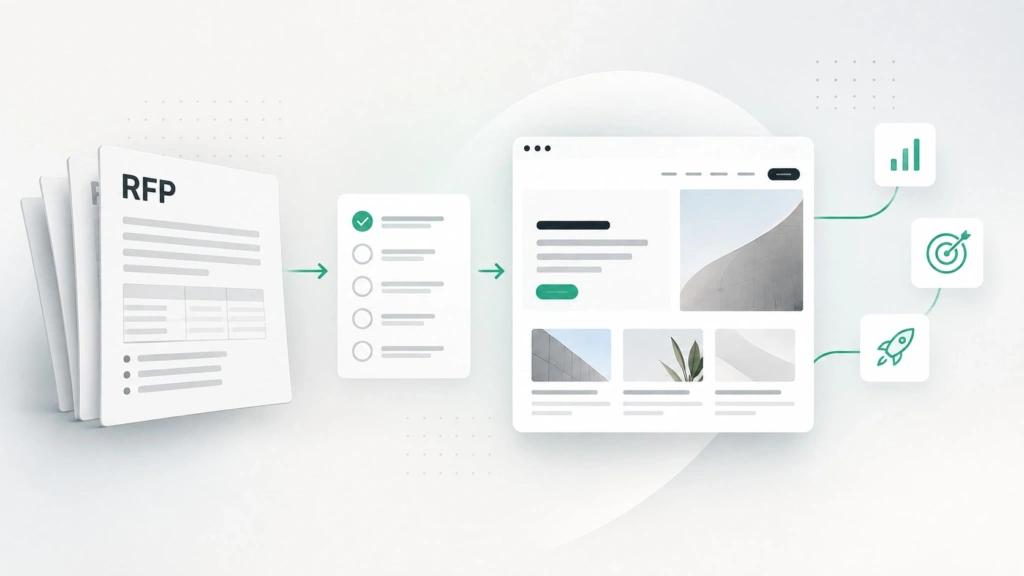

A website redesign RFP should explain why you are redesigning, what success looks like in numbers, what is in scope, your budget range and timeline, and how you will choose. It should also settle three things that are easy to leave out: what happens to your URLs and search traffic, who owns the domain, hosting and code at launch, and support after launch. For most small and mid-size B2B companies, a 2–4 page brief sent to three to five shortlisted agencies works better than a formal RFP. The copy-paste template is below.
Do you need a formal RFP or a short brief?
A formal RFP makes sense when the selection must be documented: public-sector or procurement rules, a board or several departments that must sign off, or a large build with many integrations where a wrong choice is expensive to undo.
For most small and mid-size B2B companies, that is overkill: it takes weeks to write, and agencies answer the paperwork instead of your problem. A short brief to a few agencies you have researched works better.
Skip both if you already know which agency you want: ask it for a scoped proposal and check that against the five questions below.
What should a website redesign RFP include?
Why are you redesigning?
Say what you sell, to whom and where. Then name the business problem behind the redesign: enquiries have dropped, the site no longer matches what you sell, nobody can edit it, or ad traffic lands and leaves. “The site looks dated” is a symptom; say what it costs you.
What should agencies know about your current site?
A URL alone doesn’t let anyone price a migration. Name the platform and hosting, roughly how many pages are indexed, which ones bring in traffic or leads, and what brand assets exist. Read-only access to analytics and Search Console lets shortlisted agencies price the migration from real data instead of guessing.
What does success look like?
Pick two or three measurable goals, each with today’s number: qualified enquiries per month, conversion rate on service pages, organic visits to key pages. “Modern” or “clean” can’t be checked after launch. No baselines yet? Make capturing them part of the scope.
Who is the site for?
Name the two or three buyer types the site must serve and what each needs to do: compare services, check proof, request a quote. On a B2B site, include people who don’t sign the contract, such as a procurement contact or an engineer.
What is in scope, and what is not?
Say whether you know what to build or want the agency to propose it. Then list:
- Page types, not page count. The unique templates (home, service, case study, contact) and roughly how many pages use each: ten pages on one template cost far less than ten layouts.
- Content. Who writes, edits and approves copy, and what moves as-is or gets rewritten. Settle this early: late or unapproved copy holds up design and launch.
- Integrations. CRM, booking, chat or client portal, and what each must do.
- Exclusions. What you don’t want quoted, such as a rebrand or photography.
Which technical requirements should you state?
Describe what you need and why, not which tools to use: “our marketing team must publish pages without a developer” says more than a plugin list. Name an accessibility standard, usually WCAG 2.2 level AA, and a speed target you can check, such as Core Web Vitals in Google’s “good” range on mobile: LCP within 2.5 seconds, INP of 200 milliseconds or less, CLS of 0.1 or less.
What must happen to SEO, AI search and tracking?
This part decides whether the new site keeps the traffic the old one earned. “SEO best practices” is too vague to hold anyone to; write these in as requirements:
- URL inventory and 301 map. Every moved or merged URL gets a 301 to its closest new page, mapped before design is final; pages retired on purpose return 404 or 410. No redirect chains, no mass redirects to the homepage.
- Ranking content kept. Pages that earn search traffic or enquiries are kept or merged into a stronger page, with their titles, headings and copy carried over.
- Staging blocks removed at launch. Staging stays out of Google; at launch, its noindex tags, robots.txt rules and WordPress “discourage search engines” setting come off, checked on the live domain.
- Tracking live on day one. Analytics, tag manager and conversion events work at launch; a test lead through every form reaches your inbox or CRM and shows in analytics.
- Structured data and sitemap. Schema carries over and matches the visible content; a new XML sitemap is submitted at launch.
- Monitoring. 404s and redirect errors are watched for 90 days.
- Readable by search engines and AI assistants. Crawlable links and clear headings. Nobody can honestly guarantee rankings or AI citations, so ask for the work, not a promise.
Our checklist for redesigning a website without losing SEO explains each step. A post-launch crawl showing no 404s on mapped URLs is a fair condition for final payment.
Who owns what at launch?
Vague ownership terms turn into lock-in later, in the contract. An RFP can claim the design and content and still say nothing about the domain or hosting account. Require in writing:
- The domain registered to your company, in an account you control.
- Hosting in your own account, or agency hosting with a written exit: how you get a full copy of the site, and how fast.
- Ownership of custom code, design files and content at final payment, and full admin access throughout.
- A platform another developer can take over, with paid plugins and licences listed, in your name where possible.
- Backups you can reach without asking the agency.
What happens after launch?
Ask for a defined warranty, editor training and short documentation, and for ongoing care (hosting, updates, backups, security) quoted separately, with response times for a broken page versus a cosmetic change. That way you compare the real cost of year one. Ours is a separate monthly website care plan.
Why include a budget range?
Without one, proposals aren’t comparable: the same brief can be answered as a lean rebuild or a months-long program, and an agency that can’t see your range has to guess. A range lets agencies recommend what fits the money, lets wrong-sized ones step aside, and exposes suspiciously low bids.
No number yet? Compare published prices from three or more agencies, such as our B2B website redesign pricing: a Custom Growth Website from $7,500 (8–10 weeks) for most established B2B redesigns, or a Business Website at a fixed $3,800 (3–4 weeks) for up to five core pages. We scope deeper SEO migration work, and copywriting for the Business Website, separately. Whoever you hire, the year-one total moves with copywriting, migration depth, integrations, accessibility testing and care.
How will agencies respond, and how will you decide?
Give two timelines: the process (questions deadline, an optional 30-minute call, proposal deadline, decision date) and the project (target launch and the reason for that date). Name who answers questions and who decides, who owns the project day to day, who approves designs and copy, and how fast feedback comes back; that makes an agency’s timeline believable. If several people score proposals, agree on criteria and weights first, so nobody builds a score around a favorite.
Website redesign RFP template (copy and paste)
Replace everything in brackets and delete what doesn’t apply; filled in, it fits on two to four pages. As written, it is the short brief. For a formal RFP, append your procurement sections: contract and IP terms, insurance, a data protection and security questionnaire, a conflict-of-interest statement, a pricing form and a scoring matrix.
- About us. [Company name] is a [What you do] serving [Who your clients are] in [Markets or regions]. Current website: [URL]. Questions to: [Name, role, email].
- Current site. Platform and hosting: [CMS, provider]. Indexed pages: [Approximate number]. Pages that bring traffic or leads, and what must stay: [List]. Brand assets: [Guidelines / Logo only / Needs a refresh]. Access for shortlisted agencies: [Read-only analytics, Search Console, CMS].
- Why we are redesigning. [The business problem, for example: “Enquiries have fallen for a year, and our team can’t update the site.”] [What happens if we do nothing.]
- Goals. Within [Time frame] after launch: [Goal 1: metric, today’s number, target]; [Goal 2]; [Goal 3]. [If there are no baselines: “Capture baselines before design starts.”]
- Audiences. [Buyer type 1] needs to [Task]. [Buyer type 2] needs to [Task].
- Type of project. [We know what we need built. / We know the outcome and want you to propose the approach.]
- Scope. Page types: [Each template, with approximate page count]. Content: [Who writes, edits and approves copy; what moves as-is; what gets rewritten]. Integrations: [Systems, and what each must do]. Not in scope: [Exclusions].
- Technical requirements. Platform: [Preference and why, or “open to recommendations”]. Hosting: [Our own account / Open to agency hosting with a documented exit]. Accessibility: [Standard, such as WCAG 2.2 AA]. Performance: [For example: Core Web Vitals “good” on mobile for key page templates, checked after launch]. Editing: [Who on our team must edit what, without a developer].
- SEO, AI search and tracking. Cover: a URL inventory and 301 map before design is final (retired pages return 404 or 410); pages that earn traffic kept or merged, with their content; staging-only noindex and robots.txt blocks removed at launch; analytics, [Tag manager, CRM] and form tracking working at launch; structured data carried over; a new XML sitemap; [Number] days of 404 monitoring.
- Ownership. The domain stays in our company’s name throughout, and hosting in our own account [Or: agency hosting with a documented exit]. We keep admin access during the project. At final payment we own all custom code, design files and content. List every paid plugin or licence and who holds it.
- After launch. Warranty: [Length]. Training: [Who, and how]. Quote ongoing care separately, with response times for [Critical issue, such as a broken form] and [Minor change].
- Budget. Build: [Range]. Ongoing care and marketing: [Separate range, or “not yet budgeted”].
- Timeline. Questions by [Date]. Clarification calls on [Dates]. Proposals due [Date and time zone] to [Email], as [Format and page limit]. Decision by [Date]. Target launch [Date], because [Reason]. Our team: project owner [Name], approvers [Names], feedback within [Number] business days, content ready by [Date].
- Answer these five questions in writing. What happens to our URLs? What is the site built on, and can we leave it? Who owns the domain and hosting at launch? What does the price include, and when is it paid? What happens in month two?
- Include in your proposal. [Two or three] relevant projects with live URLs; the people who would do the work; your process and named deliverables; an itemized price with payment schedule and exclusions; references, including a project that didn’t go to plan; anything this RFP missed.
- How we will decide. Decision-makers: [Names and roles]. Criteria and weights: [For example: relevant experience 25%, approach and deliverables 25%, team 15%, ownership and support terms 15%, price 20%]. We don’t expect design concepts with the proposal.
How should you evaluate redesign proposals?
Judge proposals by evidence you can check, not by polish or free mockups:
- Relevant work you can open. Live sites for companies like yours, not screenshots. Check speed and whether the path to an enquiry works.
- References you can call, including one from a project that went wrong. How an agency handled a slipped deadline tells you more than a smooth project.
- Named deliverables: audit, URL inventory, redirect map, staging, launch checks. “Discover, design, develop, launch” lists phases, not deliverables.
Then check each proposal against the five questions from our website redesign services page, which we tell buyers to ask anyone, including us:
| Question | A good answer | A weak answer |
|---|---|---|
| What happens to our URLs? | URL inventory and 301 map before design, checked after launch | “We’ll set up redirects,” or nothing |
| What is the site built on, and can we leave it? | A widely used platform another developer can take over | A proprietary builder you can’t move |
| Who owns the domain and hosting at launch? | You, in your own accounts, or a written exit | The agency, by default |
| What does the price include, and when is it paid? | Itemized scope, exclusions, dated payment schedule | One number, extras “billed hourly” |
| What happens in month two? | Warranty, training and care quoted separately, with response times | “Just let us know” |
A real quote answers all five in writing.
What are the red flags in a redesign proposal?
- No plan for URLs, SEO or tracking. A redesign without a redirect map can erase the traffic that justified it.
- The agency keeps the keys: it registers the domain or holds the hosting account, with no exit terms.
- A price without an inclusions list, or a low number with the real work moved to “additional hours.”
- A timeline with no dependencies: nothing about when content, feedback and approvals are due from you.
- Guaranteed rankings, traffic or AI citations.
- A generic proposal: no named team, nothing specific to your business.
FAQ
How many agencies should receive a website redesign RFP?
Three to five agencies you have researched. Fewer gives you too little to compare. More adds reading time without better options, and a long list tells good agencies their odds are low.
Should agencies include design concepts in their proposal?
Better not to ask for them. Concepts made before discovery show how an agency sells, not how it would solve your problem, and they ask for unpaid work some strong agencies decline. To see an agency’s thinking first, ask for a short audit of your current site or a paid discovery phase; both start from real data.
How much time should agencies get to respond?
Two to three weeks is reasonable for a considered proposal, with a questions window in the first week and an optional short call. Tight deadlines tend to produce generic proposals.
What is the difference between an RFP, an RFI and an RFQ?
An RFI (request for information) explores the market before you know what you need. An RFP (request for proposal) asks how each agency would solve your problem, and at what price. An RFQ (request for quote) compares prices for fixed requirements. Most redesigns need an RFP or a brief, because the approach matters as much as the price.
Writing an RFP for your redesign?
Send it to us as well. We answer the five questions in writing, and our website redesign process for B2B companies starts with a free video audit of your current site, so you know whether it needs targeted fixes or a rebuild before comparing quotes. Price, payment schedule and a dated timeline are agreed before design starts. After launch, we can stay on with care and SEO & AI search plans.
