

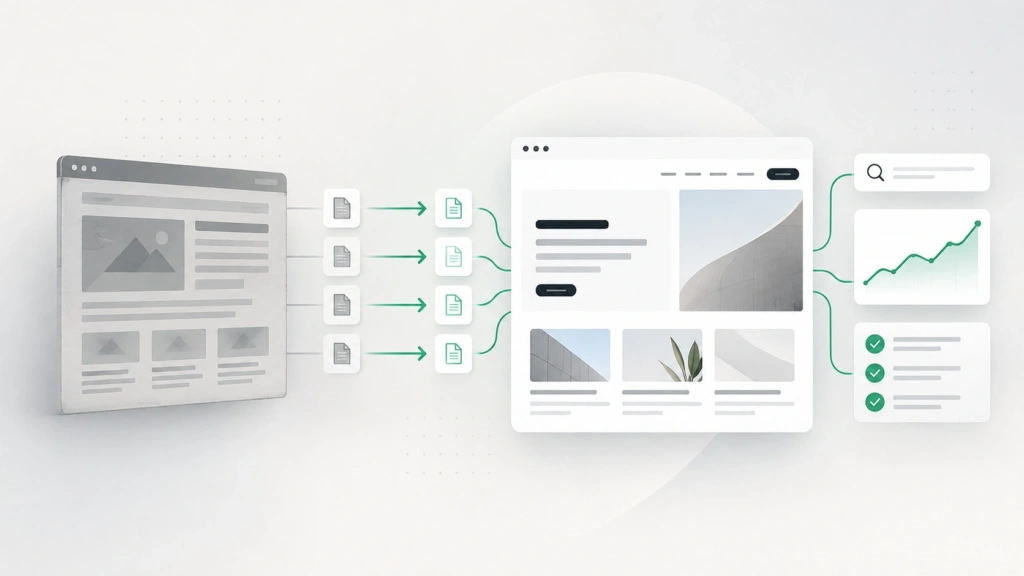

A website redesign loses SEO for a few specific reasons: URLs change without redirects, pages that earned traffic disappear, copy that ranked gets rewritten, or staging settings go live with the new site. You keep what you have earned by measuring first, redirecting every changed URL to its closest new page, carrying over the content that ranks, testing on staging, and watching Search Console for 90 days. Some movement is still normal: Google says rankings can fluctuate while it recrawls a changed site, then settle.
This SEO migration checklist follows Google’s guide to site moves with URL changes. The URL inventory, 301 map and staging checks are the same steps we build into client redesigns.
Key takeaways
- Export a baseline from Search Console and analytics before design starts.
- Inventory your URLs. Keep every URL that doesn’t need to change; merge, move or retire the rest on purpose.
- Redirect each changed URL to its closest new equivalent with a server-side 301. No chains, no mass redirects to the homepage.
- Carry over the titles, headings and copy of pages that already rank.
- Build on a protected staging site, and at launch remove the noindex rules and robots.txt blocks that were only there for staging.
- Run the launch-day checks in order: redirects, indexing, sitemap, forms.
- Watch Search Console and enquiries against your baseline for 90 days.
Why do websites lose traffic after a redesign?
Traffic drops when a redesign removes or hides something Google was already using:
- Changed URLs with no redirect. The old address returns a 404. Google removes indexed URLs that start returning 4xx codes, and links pointing to them stop helping.
- Pages dropped carelessly. A page that quietly brought in enquiries is left out, or redirected to the homepage.
- Rewritten content. Titles, headings and copy that matched real searches get cut to fit a cleaner layout.
- Staging settings left on. A noindex tag, a robots.txt block or a canonical pointing at the staging domain goes live.
- Navigation Google cannot follow. Google can generally crawl a link only if it is an
<a>element with anhref. Script-only menus can hide whole sections. - Too many changes at once. Google advises planning changes “one after the other, not everything at the same time.” Its Change of Address help adds that pairing a move with a redesign of content and URL structure will probably cause some traffic loss while Google relearns the pages.
What should you measure before the redesign starts?
A baseline is the only way to tell a normal wobble from a real loss. Export it before design starts:
- Search Console Performance: clicks, impressions and position by page and query. Export 16 months so you can compare the same season after launch.
- Analytics by landing page: organic sessions and key events (form submissions, phone clicks, booked meetings). On a B2B site, enquiries per page matter more than sessions.
- AI referrals: visits from assistants such as ChatGPT and Perplexity, and the pages they land on.
- A full crawl of the live site: every URL with its status code, title, H1, meta description, canonical and structured data. This becomes your staging checklist.
- Links: most-linked pages from the Search Console Links report.
- Speed: PageSpeed scores for each main template, so the new build has a number to beat.
How do you build a URL inventory and decide what to keep?
Every URL that has earned traffic or links needs a decision before the new structure is final. Google suggests starting with your important URLs and pulling them from XML sitemaps, top-traffic pages in analytics, the Search Console Links report, a CMS export and recent server logs. Include images and PDFs; they may already get search traffic.
Then give each URL one of five decisions. Keep is the default: Google’s guidance on domain moves notes that keeping the same site architecture helps pass signals to the new site.
| Decision | Use it when | Old URL at launch |
|---|---|---|
| Keep | The page performs and its URL still fits | Returns 200 at the same address |
| Improve | Right topic, but thin or out of date | Same address, better content |
| Merge | Several pages cover the same topic | 301 to the combined page |
| Move | The page stays, but its URL must change | 301 to the new URL |
| Retire | No traffic, no links, no replacement | Returns 404 or 410 |
On our projects, the URL inventory and the 301 map come after the audit and before design starts, because the map shapes the new structure. It is part of how we run a website redesign for B2B companies.
How should the 301 redirect map work?
The redirect map is a spreadsheet: one row per old URL, one destination, one status code.
| Old URL | New URL | Status |
|---|---|---|
| /services.php?id=4 | /services/website-design/ | 301 (moved) |
| /seo-services/ and /seo-company/ | /services/seo/ | 301 (merged) |
| /files/brochure-2023.pdf | /downloads/brochure.pdf | 301 (moved) |
| /news/2019-trade-show/ | none | 410 (retired) |
The rules, from Google’s site-move and redirects documentation:
- Use server-side permanent redirects. Set 301 or 308 redirects in the server configuration or your CMS. Google says server-side redirects have the highest chance of being interpreted correctly; JavaScript redirects are a last resort.
- Send each URL to its closest equivalent. Several old URLs can point to one new page if it consolidates their content.
- Do not send everything to the homepage. Google warns that many old URLs redirected to one irrelevant page can confuse users and may be treated as a soft 404.
- Avoid chains. Google’s crawlers follow up to 10 hops, but Google advises redirecting straight to the final URL (if unavoidable, “ideally no more than 3 and fewer than 5” hops). If the site was redesigned before, point old redirects directly at the new URLs.
- Let retired pages return 404 or 410. Google has said that 404s on some URLs don’t hurt how the rest of the site performs. Check that your custom 404 page returns a real 404 status.
- Keep redirects for at least a year. Google says “as long as possible, generally at least 1 year,” so it can reassign links from other sites.
One step you can skip: Search Console’s Change of Address tool is only for moving to another domain or subdomain. A same-domain redesign does not need it.
What content and on-page elements must carry over?
A new design should change how a page looks, not what it tells Google. For every page you keep, improve or move, check:
- Title tags. Every page has a descriptive, distinct title. Titles that already rank stay unless there is a clear reason.
- H1, H2s and body copy. The text that answers the search stays, even when the layout gets cleaner.
- Internal links. Menus, footers and in-text links point to the new URLs directly, not through redirects, using real
<a href>links. - Canonical and hreflang tags. Each new URL has a self-referencing canonical with an absolute URL on the live domain, and any hreflang points to new URLs. Google notes relative canonicals can cause problems if a testing site gets crawled.
- Structured data. Schema carries over and still matches the visible text.
- Images, alt text and meta descriptions. Carried over or changed on purpose, never lost in the rebuild.
How do you set up and test a staging site safely?
Build on staging and switch over once the new site works. Staging must stay out of Google and prove the new site matches the old one where it counts.
Keep staging out of Google
Password protection or an IP restriction is safest: password-protected content stays out of Google Search. If the staging hostname must be public, add noindex. Noindex only works if robots.txt doesn’t block the page: Google must crawl it to see the tag.
Prepare the launch settings in advance
Google recommends preparing, during development, the robots.txt you will use at launch and a list of URLs where noindex rules will come off. On WordPress, add the “Discourage search engines from indexing this site” setting to that list. Keep your Search Console verification file or meta tag in the new build. Make sure hosting has headroom before launch: Google temporarily crawls a moved site more heavily than usual.
Compare staging with the live site
Crawl staging and compare it with the baseline crawl, URL by URL: status, title, H1, canonical, main copy and structured data. Run the full URL inventory against staging with a script: redirected URLs should reach a 200 page in one hop, kept URLs return 200 directly, and retired URLs return 404 or 410.
Test the path to an enquiry
Submit every form and confirm it reaches the inbox or CRM and fires the analytics key event. Click every phone link and booking button. Never assume tracking carries over to new templates.
What should you check on launch day?
Work through these in order.
- Pick a lower-traffic window, as Google suggests.
- Back up the old site and keep its final crawl.
- Switch to the new build with the redirect map already active, and move all URLs at once, as Google recommends for small and medium sites.
- Straight away, remove staging protection: the password, the noindex rules on your list, the WordPress “discourage search engines” setting. Put the production robots.txt in place.
- Confirm Search Console verification still works.
- Rerun the staging URL script on the live domain: redirected URLs return one 301 to a 200 page, kept URLs return 200, retired URLs return 404 or 410.
- Check your 10–20 most important pages with the URL Inspection live test: indexable, correct canonical, fully rendered.
- Crawl the new site for internal links that hit redirects or 404s, and canonicals still pointing at staging.
- Submit the new XML sitemap in Search Console, listing only final, canonical, absolute URLs.
- Send a test lead through every form and confirm it in the CRM or inbox and in analytics.
- Update links you control: Google Business Profile, social profiles, directories, email signatures, ad landing pages.
- Annotate the launch date and time in analytics.
What should you monitor in the first 30, 60 and 90 days?
Google gives no fixed recovery date; for a small to medium site, it says most pages can take a few weeks to move. This schedule is a working rhythm, not a Google deadline.
| When | Check | Normal | Act if |
|---|---|---|---|
| Days 1–7, daily | Search Console and server logs for 404s and redirect errors; leads | Old URLs still in results; heavier crawling | 404s on mapped URLs, redirect errors, pages excluded by noindex, no form events |
| Days 8–30, weekly | Page indexing report; Performance by page against baseline | Old URLs shown as “Page with redirect”; positions moving | New URLs not indexed; key pages losing clicks week after week |
| Days 31–60 | Top queries and pages against baseline; sites still linking to old URLs | New URLs gaining impressions and clicks | A page that ranked before is still missing: compare old and new content |
| Days 61–90 | Same period last year; enquiries by landing page | Most search traffic on new URLs | Traffic holds but enquiries fall: check the forms |
A leftover noindex takes effect as Google recrawls each page, so it causes a slow decline, and a quiet first week proves nothing. Old URLs can linger in results for a while; Google calls this normal and says they fade on their own.
Does a redesign affect visibility in AI search?
It can, for the same reasons it affects rankings. Google says there are no additional requirements to appear in AI Overviews or AI Mode beyond normal SEO best practices: a page must be indexed and eligible to show with a snippet to appear as a supporting link. No special AI text files or markup are needed.
So the protection is the same work: crawlable pages, clear headings, preserved URLs, and quoted pages left intact. Before launch, note which pages AI assistants send visitors to and treat them like your top organic pages; after launch, compare those referrals against your baseline. Google counts clicks from its AI features in Search Console under the “Web” search type. No schema or llms.txt file guarantees a citation. Because the work overlaps, we handle SEO and AI search as one scope in our SEO and AI search management.
When is a redesign the wrong fix?
A redesign is a big change. Discussing small ranking dips, Google’s traffic-drop guide recommends “avoiding making radical changes if your page is already performing well.” Check whether a smaller fix solves the real problem:
- The site is slow: a performance pass on the current build.
- Two or three pages underperform: rewrite those pages.
- Traffic arrives but enquiries don’t: fix the forms, calls to action and path to an enquiry.
- The offer has changed: new positioning and copy on the same foundation.
A rebuild makes sense when the foundation is the problem: nobody can edit the site, plugins are abandoned or insecure, the build cannot be made fast, or the structure cannot hold what you sell today. Changing platforms, say from Wix, Webflow or a heavy page builder to WordPress, follows the same URL inventory and 301 steps; that is how we run our WordPress migration services.
That is why our website redesign process starts with an audit. Sometimes the honest answer is targeted fixes under a website care plan, not a rebuild. For ECA, an audit and fixes took the corporate site to 90/100 on PageSpeed, and two new landing pages reached 100/100.
FAQ
Will a website redesign hurt my SEO?
It can, if URLs change without redirects, ranking content is removed, or staging settings go live. A complete redirect map, carried-over content and a launch-day check address all three. Some temporary fluctuation is still normal.
How long does SEO take to recover after a redesign?
Google gives no fixed timeline. It says rankings can fluctuate while it recrawls a changed site and will settle down over time. For medium-sized sites, showing the new URLs can take a few weeks or more, longer for large sites. If key pages are still below your baseline after that, compare the old and new content, then check redirects, noindex and canonicals.
How long should I keep 301 redirects after a redesign?
Google’s site-move guide says “as long as possible, generally at least 1 year,” and suggests keeping them indefinitely for users. The 180-day figure you may see comes from Google’s Change of Address help, for domain moves.
What happens to my backlinks during a redesign?
If the linked URL 301-redirects to its closest equivalent, the link keeps working, and Google says permanent redirects don’t cause a loss in PageRank. Redirects are slower for visitors, so ask the sites that send the most traffic to update their links.
Should I delete old pages during a redesign?
Only after checking their traffic and links. A page with no traffic, links or replacement can return 404 or 410. Merge overlapping pages and 301 them to the combined page, not to the homepage.
Should I launch the new site all at once or in sections?
For small and medium sites, Google recommends moving all URLs at the same time; large sites can move section by section. What Google advises against is stacking big changes: a new domain, CMS and design are better done one after another. If a new CMS and a new design must launch together, don’t add a domain change on top, and keep URLs and ranking content as stable as possible so Google has less to relearn.
Planning a redesign?
If you want the URL inventory, the 301 map and the staging checks built into the project before design starts, see our website redesign services. We start with a free video audit of your current site and tell you whether it needs fixes or a rebuild. After launch, we can stay on with separate care and SEO & AI search plans. Comparing agencies first? Use our website redesign RFP template.
